Team Assessment
Understanding the culture
that enables change
Making the invisible visible
An organization can only be as strong as the culture that sustains it.
Yet many leadership teams know that culture matters – but not which values are actually lived, what truly matters to people, and where friction arises.
With the Barrett Values Assessment, we make these invisible factors visible.
It clearly shows which values shape the organization today, which are crucial for the future, and where the greatest opportunities for development lie.
This creates a reliable foundation for real, sustainable change.
aergon is a certified partner of the Barrett Values Centre.
Why team assessments are indispensable today
Corporate culture shapes critical factors such as speed, collaboration, motivation, willingness to change, and leadership quality.
It therefore determines productivity, innovative strength, and the ability to attract and retain top talent – ultimately, business success.
And yet, many organizations operate blindly.
Emotions, unspoken tensions, loss of trust, and misunderstandings have strong effects but are difficult to grasp without data.
A team assessment creates clarity:
- Which values are personally important to your employees?
- Which values are currently experienced in the organization?
- Which values does the company need for a successful future?
These three perspectives immediately reveal where culture strengthens – and where it slows you down.

Our approach –
making culture measurable, enabling change
The Barrett Values Model –
a sound foundation for cultural development
The Barrett Values Model describes seven levels of values that show how people and organizations think, decide, and act. It reveals which values currently shape the culture, which are unconsciously missing, and which are critical for future success.
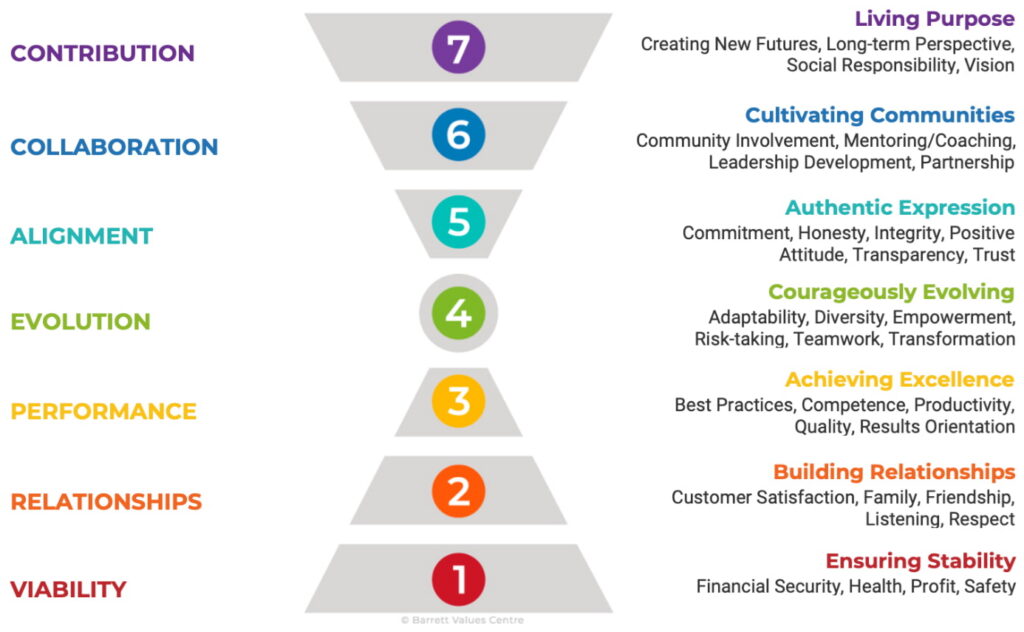
The levels are grouped into three areas:
1. Foundation (Levels 1–3): Stability, safety & collaboration
These levels form the foundation of every organization and show whether the basics are solid:
- Viability: stability, efficiency, clear structures
- Relationships: trust, respect, psychological safety
- Performance: results orientation, clarity, accountability
Why this matters:
An organization cannot be innovative or purpose-driven if its foundation is unstable. Barrett reveals where friction, silos, or unnecessary bureaucracy exist.
2. Evolution (Level 4): Growth & learning
This level describes an organization’s ability to develop courageously:
- Evolution: willingness to change, reflection, new thinking, experimentation
Why this matters:
This is where it is decided whether transformation succeeds or whether organizations cling to the past while the world moves on.
3. Impact (Levels 5–7): Identity, engagement & purpose
The upper levels describe cultural maturity:
- Alignment: authenticity, integrity, clear values
- Collaboration: cooperation, network thinking, co-creation
- Contribution: purpose, societal impact, vision
Why this matters:
Organizations living these levels have strong attraction. They win talent, retain top performers, and create environments where people want to give their best – not have to.
In times of crisis, stability, safety, and collaboration often dominate. But if organizations focus only on these, the foundation quickly becomes a limitation.
Sustainable success requires balance.
All seven levels must be considered – not only structure and security, but also development, identity, engagement, and purpose.
Under pressure, these aspects are often neglected – if they were ever addressed at all. This is why leadership needs a clear view: where must adjustments be made?
A team assessment provides exactly this transparency:
It shows where your organization stands today – and where true future readiness can emerge.

What makes the Barrett Values Assessment special
It shows:
- where your culture truly stands (not just what leadership believes)
- which values employees miss – and why this leads to conflict, turnover, or performance loss
- which values inspire as a future vision and provide orientation
- how strong cultural “entropy” is – the energy loss caused by mistrust, lack of clarity, or politics
- which development areas should be prioritized
In short:
It turns an invisible topic – corporate culture – into clearly measurable data.

Who is behind this?
I am Beate Junginger, founder and CEO of aergon. I support leaders, teams, and organizations in consciously shaping change – with clarity, integrity, and heart.
I am passionate about connecting people with their true nature, their talents, and their collective strengths – so that meaning and trust can grow into sustainable success.
What our clients say

“Being able to measure the rather soft and diffuse factors of corporate culture was extremely valuable. The results became a springboard for intensive dialogue and gave us a much deeper understanding of the factors required for a successful future.”
WERNER ZIRLIK
Director of Division Media Distribution, MELO Group
Frequently asked questions
What is the Barrett Values Assessment?
The Barrett Values Assessment measures the values lived in an organization from the employees’ perspective. It shows which values currently dominate, which are desired, and where cultural tensions or friction arise – making culture visible and actively shapeable.
Why is this relevant for the leadership team?
Culture influences performance, collaboration, and the ability to change. The assessment provides a clear foundation to develop culture in line with strategy, leadership, and future goals. It helps uncover blind spots and build trust.
How does the assessment work?
Employees complete a short online questionnaire (about 15 minutes). The results are anonymous and aggregated. In a joint workshop, we analyze the findings, identify development areas, and define concrete next steps.
What distinguishes Barrett from other tools?
Barrett is based on a values-driven model that connects individual, organizational, and societal levels. It shows not only what is, but also what could be – and how large the gap is. This makes it particularly powerful for transformation and leadership development.
How anonymous is the survey?
Participation is voluntary, anonymous, and GDPR-compliant. Results are presented only in aggregated form. No conclusions about individuals are possible. This creates trust and openness across the organization.
Make your culture measurable and intentionally shapeable
Rely on clarity, data, and shared responsibility. With the Barrett Values Assessment, you create the foundation for a values-driven, future-ready culture and a form of leadership that truly sustains.
Contact form