Creative word salad instead of cultural truth
Wanting to sound original, companies create terms that sound good but lack grounding. Values must be lived, not impress. Empty slogans destroy credibility.


Provide direction. Unlock energy. Shape the future consciously.
In times of constant transformation, management alone is no longer enough. Markets change faster, expectations shift, and people ask fundamental questions about meaning, purpose and contribution. Employees want to feel why they do what they do, and what is worth investing their energy in. Traditional goals such as growth and profit alone hardly motivate anyone any more.
This is why vision, mission and values become the central steering mechanism for culture, prioritization and leadership behavior. They create clarity about direction, identity and decision criteria, and become an emotional source of strength that carries teams through challenging phases.
An inspiring vision, a mission with societal value and lived values provide orientation and attract both customers and top performers.
Especially in volatile times, a clear vision acts like a North Star: it provides direction, inspires and answers the question of what for, so that people commit and mobilize energy even in difficult phases.
Values, however, often remain abstract. That is why we develop principles: operationalized values that speed up decisions. A principle makes concrete how we act when it matters. Once a decision has been made, it does not have to be debated again every time, and nobody has to explain why something is no longer up for discussion: the principle already explains it.
The vision sets the direction, the principles set the pace.


We develop vision, mission, and values together with a selected group of key stakeholders from relevant levels and functions of your organization.
Always guided by two core principles:
We combine strategic clarity with psychological impact. We translate the organization’s future scenarios into an activating picture of sustainable success and strong culture.
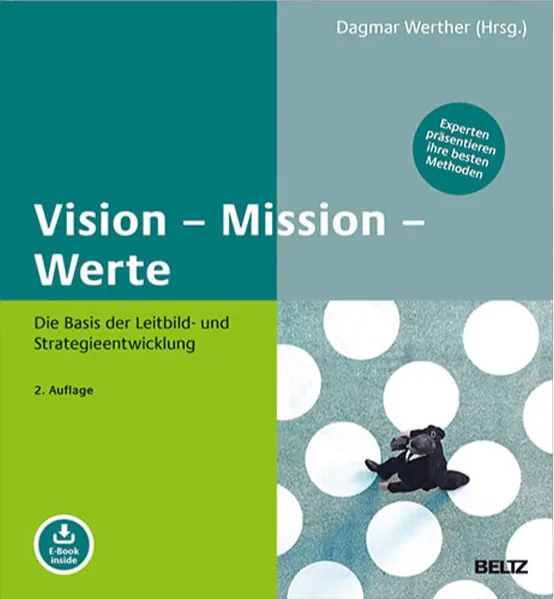
Die Basis der Leitbild- und Strategieentwicklung.
In times of major change, people in organizations need orientation more than ever – to deal with uncertainty, find common direction, and allocate their resources wisely. This requires a meaningful, emotionally engaging vision that also serves as a benchmark from which strategies are derived – not the other way around.
You will find my contribution “Lost in Transformation” in the first chapter, “Values and Visions in Times of Transformation”, right at the beginning of the book. Together with outstanding colleagues, we have compiled our best ideas and methods.
Go to the aergon libraryMany organizations do not fail because they lack a vision, but because of how they develop vision and values.
The most common pitfalls:
Wanting to sound original, companies create terms that sound good but lack grounding. Values must be lived, not impress. Empty slogans destroy credibility.
“We want to become market leader” is not a vision – it is an outcome. A true vision creates emotion, pull, energy, and focus – especially when times are tough.
If mission looks like branding but does not drive decisions, it is ineffective. Employees must understand: what we do, for whom, and why in this way.
The most powerful values already exist – implicitly. When companies “invent” values, culture becomes artificial and teams disengage. Values that are not lived are worthless.
Vision, mission, and values are not a poster project. The real leverage begins when leadership consistently bases strategies, priorities, KPIs, and projects on them.
If vision, mission, and values are developed in the boardroom and then “rolled out,” they remain foreign. Transformation requires co-creation – otherwise it will be internally blocked.

I am Beate Junginger, Founder & Managing Director of aergon. I support leaders, teams, and organizations in consciously shaping change – with clarity, integrity, and heart.
I am passionate about connecting people with their true nature, their talents, and their collective strengths – so that meaning and trust can grow into sustainable success.
More about Beate JungingerA clear vision and lived values foster identification, strengthen collaboration, provide strength especially in turbulent times, and attract the right employees and customers.
By developing it together with key people from all levels – practical, emotionally relatable, and culturally anchored. This is not about being as creative or original as possible, but about true fit.
Vision and values become the benchmark for all initiatives, KPIs, and collaboration.
This is the only way to ensure that your team knows the destination and stays consistently on course.
This depends on company size and objectives. For an initial draft of vision, mission, and values, 1–2 workshop days are a realistic and proven framework, followed by feedback loops and then a large workshop with all leaders to operationalize the content and create emotional connection.
Absolutely – and it should be. Not to invent new “marketing values,” but to uncover the existing ones that support the path toward the vision. We build on what already exists, test relevance and fit, and develop a viable future orientation from there.
Let’s explore together how to turn vision, mission, and values into a real driving force in your organization.
The button opens the booking calendar (Microsoft Bookings).